
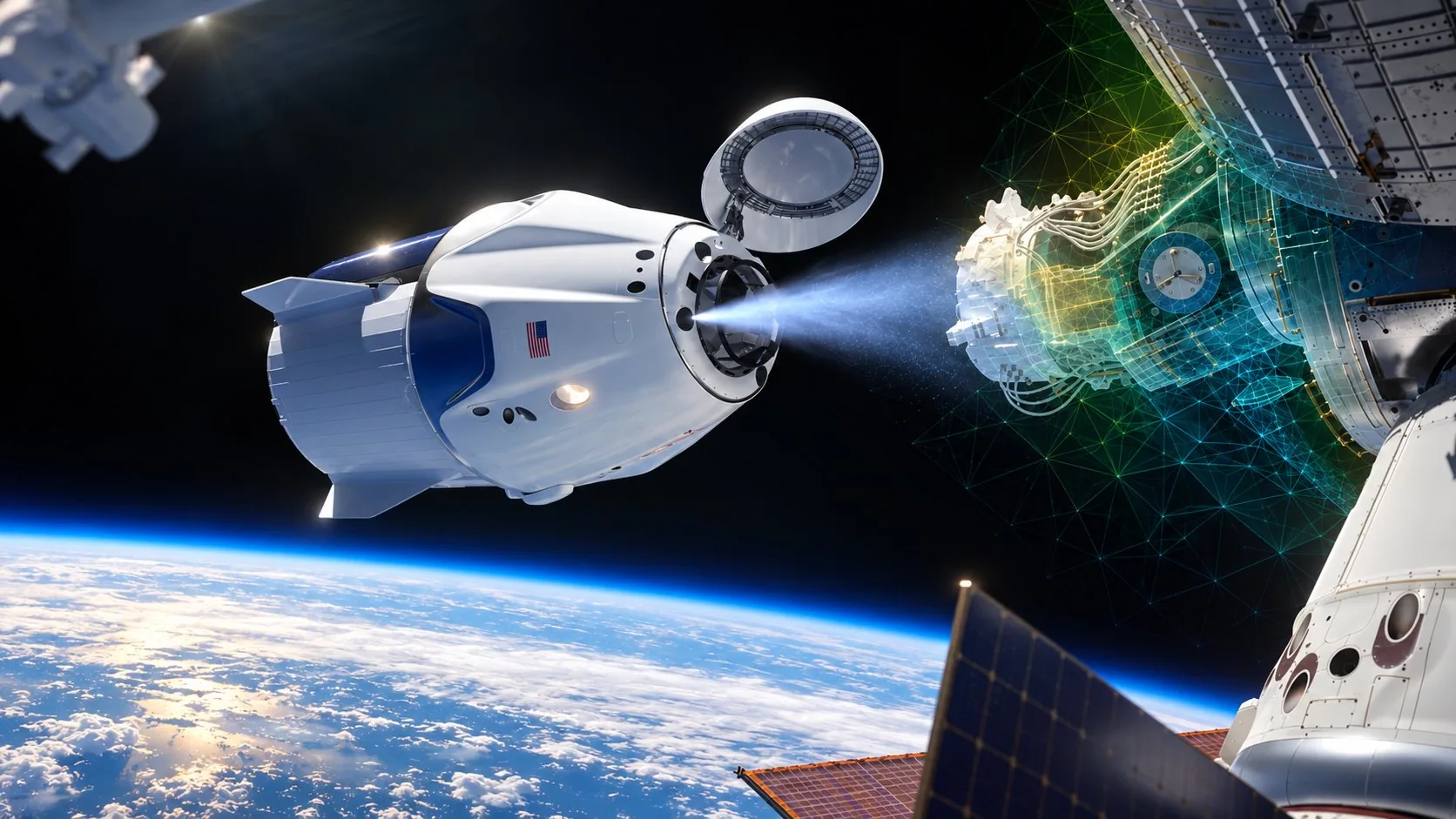
Plume impingement, predicted.
Thruster plumes can strike nearby spacecraft. Our physicists predict them from the nozzle to the spacecraft next to it, across the transition from continuum to rarefied flow.
Thruster plumes strike nearby spacecraft.

The gas is rarefied

Months of preparation

The plume crosses regimes
Know the closest safe firing range, before the rendezvous.
Watch a Physics Twin take a satellite model and a one-page mission brief to a firing rule: how close a repair craft can fire its retro thruster without pushing the solar array or heating the sun sensor past their limits.
- Force on the solar array and heat on the sun sensor, firing by firing
- Change the range or firing position and see the answer update
- 23 rarefied plume firings, each under 3 minutes on one graphics processing unit (GPU)
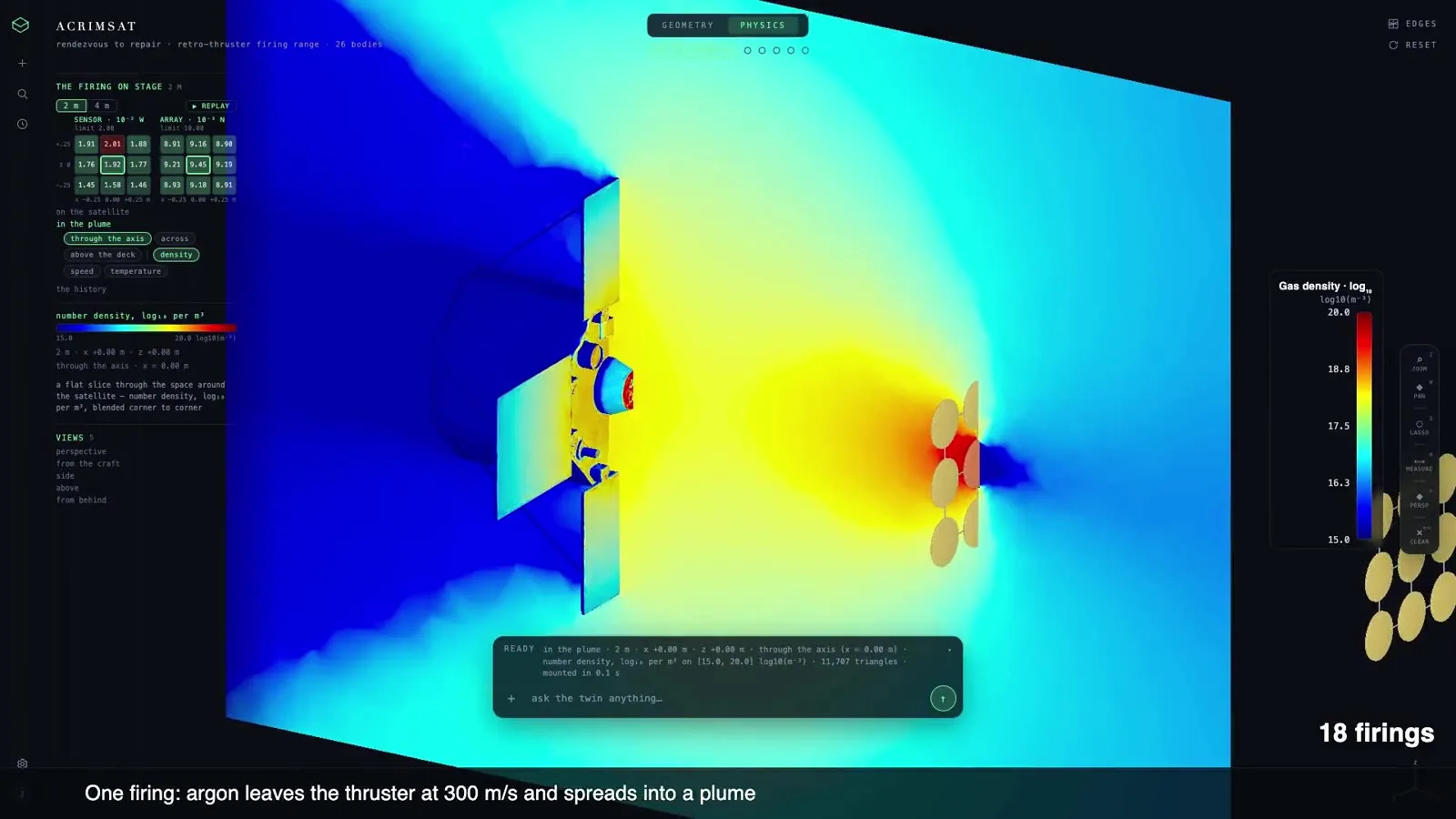
Where continuum flow ends, rarefied flow begins.
Far from the nozzle, gas molecules collide so rarely that the continuum equations behind classical computational fluid dynamics break down. The standard answer is direct simulation Monte Carlo (DSMC): accurate, but slow.
The hardest cases sit in between, where the plume crosses from continuum to rarefied flow. Traditional workflows couple CFD near the nozzle with DSMC downstream. Choosing where to hand off, and passing a consistent flow state across that boundary, makes hybrid CFD–DSMC fragile and difficult to set up.
That transition is where Flexcompute is strongest. Our Tokenized Physics approach carries the plume from continuum through rarefied flow in one model, at a fraction of the cost of DSMC.
One plume, three regimes
Powered by Tokenized Physics.
Keep the physics that matters. Make the computation practical.
| Aspect | Hybrid CFD–DSMCTwo solvers, stitched together. | Tokenized PhysicsOne model, nozzle to target. |
|---|---|---|
| Turnaround | 78 hours per caseOn a 64-core central processing unit (CPU), for the same docking case. | 0.4 GPU-hours per caseAbout 195× faster than hybrid CFD–DSMC on a 64-core CPU. |
| Regimes | A handoff to get rightCFD near the nozzle, DSMC downstream, joined at a boundary chosen by hand. | Continuum to rarefied, in one domainThe full plume, from the thruster to the docking adapter, with no coupling boundary. |
| Fidelity | The reference standardHigh fidelity in rarefied flow, at a cost that climbs as the flow gets denser. | Under 3.5% difference in integrated loadsAxial force within 2.84% and heat flow within 3.35% of hybrid CFD–DSMC. |
The compute difference, in one docking case.
About 195× faster than hybrid CFD–DSMC on a 64-core CPU, with integrated loads within 3.5%.
Results from one notional case: a 100 N thruster firing at the International Space Station docking adapter from 30 m. Not a guaranteed runtime for every design. Hybrid CFD–DSMC used Flexcompute Flow for CFD and the GPU-accelerated SPARTA code for DSMC. Source: Tokenized Physics for Rarefied Plume Impingement, Flexcompute white paper, October 2026.
Analysis, up to 200× faster.
potential analysis speedup against direct simulation Monte Carlo
not months, to predict

Plume impingement prediction for docking, rendezvous and station keeping, developed with Northrop Grumman.
Flexcompute's Tokenized Physics approach has the potential to speed up analysis ~200× compared with Direct Simulation Monte Carlo, allowing us to explore a much larger range of plume interaction scenarios to support mission demands.
What's next for space simulation.
Plume impingement is the first. The same Tokenized Physics approach is extending to other space problems where continuum and rarefied flow meet.

Lunar landing

Thermal radiation

Your next mission problem
Working on a space problem we haven't listed? Bring it to us.
Talk to SolutionsPlume impingement, answered.
What is plume impingement?
Plume impingement is the interaction between a thruster's exhaust and nearby spacecraft structures. When a spacecraft fires its thrusters during docking, rendezvous or station keeping, the exhaust plume pushes on neighboring surfaces, producing forces and moments that a control system has to anticipate. Northrop Grumman describes it as critical for station keeping, rendezvous and space robotics.
Why is plume impingement hard to simulate?
In orbit, a thruster plume expands into near-vacuum, where the gas becomes rarefied and classical computational fluid dynamics no longer applies. Specialized methods such as direct simulation Monte Carlo (DSMC) are used instead, and they are expensive. Where the plume crosses from continuum to rarefied flow, workflows often couple computational fluid dynamics with DSMC, and that hybrid handoff is difficult to set up. Accurate spacecraft control has therefore required months of mission preparation to generate large datasets from high-fidelity physics simulation.
How does Flexcompute predict plume impingement faster?
Flexcompute's Tokenized Physics approach carries rarefied physics at a fraction of the cost of DSMC. It is particularly strong where the plume crosses from continuum to rarefied flow, handling that transition in one model instead of a hybrid computational fluid dynamics and DSMC handoff. With Northrop Grumman, Flexcompute is applying it to plume impingement for docking, rendezvous and station keeping.
The first two answers draw on the Flexcompute and Northrop Grumman press release, April 21, 2026.